Source code found on old 8 inch floppy disks
Two months ago I bought about 70 old 8 inch disks for little money. They were all used and not erased. On the labels date information from the early 80's were to be recognized.
The recognition of the disk format went quite fast, since on nearly all disks the designation "Record Length 128 Byte" appears. Under UniFORM I selected the standard CP/M format SSSD: 77 tracks, 26 sectors, 128 bytes/sector. And ... It worked immediately. That was almost too easy.
There wasn't a single one of the old 8-inch disks that wasn't readable. These disks are about 35 years old! Since about 1980 no one has probably read these disks. The 8 inch drives were also out of fashion.
It's a bit like treasure hunting or looking into ancient bookcases. Just like when you were a child, just be curious and browse everything.
The CP/M files on the disks (PIP.COM, CPM.COM, DDT.COM, ...) all have the following copyright: "COPYRIGHT (C) DIGITAL RESEARCH, 1978 ... CP/M VERS. 1.4". The diskettes were therefore used on a computer with the first CP/M version 1.4.
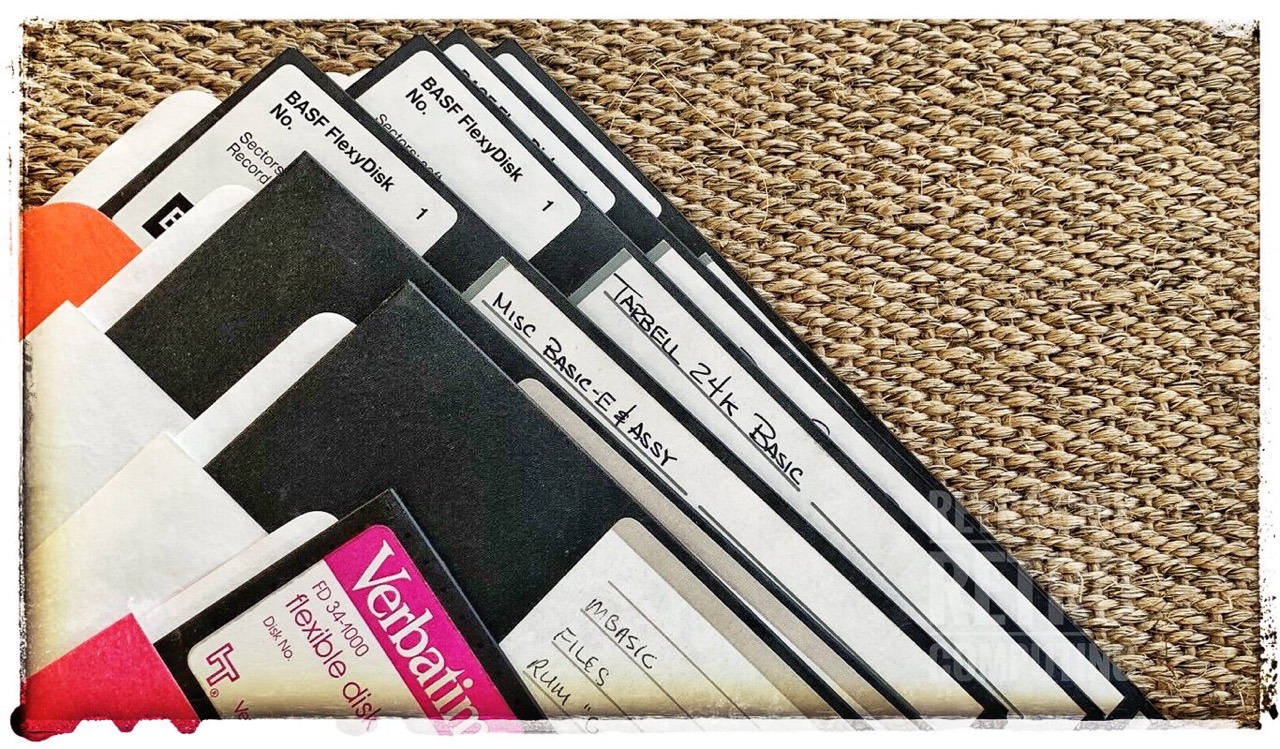
Two disks were labeled TARBELL 24K BASIC. These two disks contain a few CP/M programs, 17 assembler files (TBASIC1.ASM to TBASIC17.ASM) and a file named TLABELS.DOC (label description).
About Tom Dilatush
Of course, the name TOM DILATUSH, the designer and programmer of TARBELL BASIC, immediately catches the eye. Tom Dilatush currently runs the website JamulBlog. There you can also find a call of revenge for the death of Don Tarbell. Tom Dilatusch is currently also very active on Twitter (@SlightlyLoony1).
* TARBELL BASIC SOURCE MODULE #1
* COPYRIGHT (C) 1978, 1979 TARBELL ELECTRONICS
* LAST CHANGE TO MAKE 11.8 FROM 11.7 MADE 3-15-79.
* LAST CHANGE TO THIS MODULE MADE 3-13-79.
YES	EQU	0FFFFH
NO	EQU	NOT YES
ORG	0A00H
* DESIGNED BY TOM DILATUSH AND JIM BARNICK OF
* REAL TIME MICROSYSTEMS, CHULA VISTA, CALIFORNIA
* CODED BY TOM DILATUSH, WITH A LITTLE HELP
* FROM TOM GALLANT, BOB BROWN, AND SAM SINGER
*
* COMMON MODULE
START	JMP	STARS
        DW	CHANL	;POINTER TO CHANL
        DW	TRMNL	;POINTER TO TRMNL
        DW	SSSS	;POINTER TO SSSS
        DW	CNVRA	;POINTER TO CNVRA
        DW	USER	;POINTER TO USER ADDRESS
        ...
        ...
The very first programming I ever did for money was done for a guy named Don Tarbell. If you're old enough to remember the early, heady days of microcomputers, you'll know that name – he manufactured an S-100 board that became the gold standard of cassette tape data storage. He also made one of the first affordable floppy disk interface boards, also for the S-100 bus.
He's got a special place in my memory for a different reason, though: way back in 1976 or 1977, he published an RFQ (request for quote) for someone to write a Basic interpreter. He wanted something with better features than could be found on the then-standard Microsoft Basic, and he wanted to sell it at a low price. I answered that RFQ with an absurdly low bid (and and even more absurdly fast delivery) and absolutely nothing else to recommend me. At the time, I was still in the U.S. Navy (I didn't know it, but it was against regulations for me to engage in a contract!). I had never written any software for money before. I had no education in software engineering. I had no references. I had no samples of my work. And I had never even seen a Basic program before. Don talked with me on the phone, and ended up giving me a contract.
Later he told me that all the other quotes he'd received were 25 or more times the price I had quoted, and all the delivery times were 4 or more times what I quoted. So he figured he didn't really have much to lose by trying me out; if I failed (something he thought was a high probability), he could still go with another contractor. Well, I didn't fail – I delivered it on time, collected my hard-earned payment, and then went on to have a very good relationship with Don, delivering many enhancements over the next couple of years. That contract was the start of my career in software engineering.
Quote: Tom Dilatush, http://www.jamulblog.com/2008/05/don-tarbell.html
Downloads
The source code I found on the two 8 inch disks is not the same one published in the CP/M User Group (No. 31, 32).
- CPMUG .... RELEASE 5.2 AUGUST 16, 1978
- My disks . RELEASE 11.8 MAR 15, 1979
On 02.11.2019 I contacted Tom Dilatush via Twitter. He kindly granted permission to release the source code here for download. Disk 1 and 2 are the original files found on the 8" disks. The 3rd download are only the assembler files renamed to *.txt.